
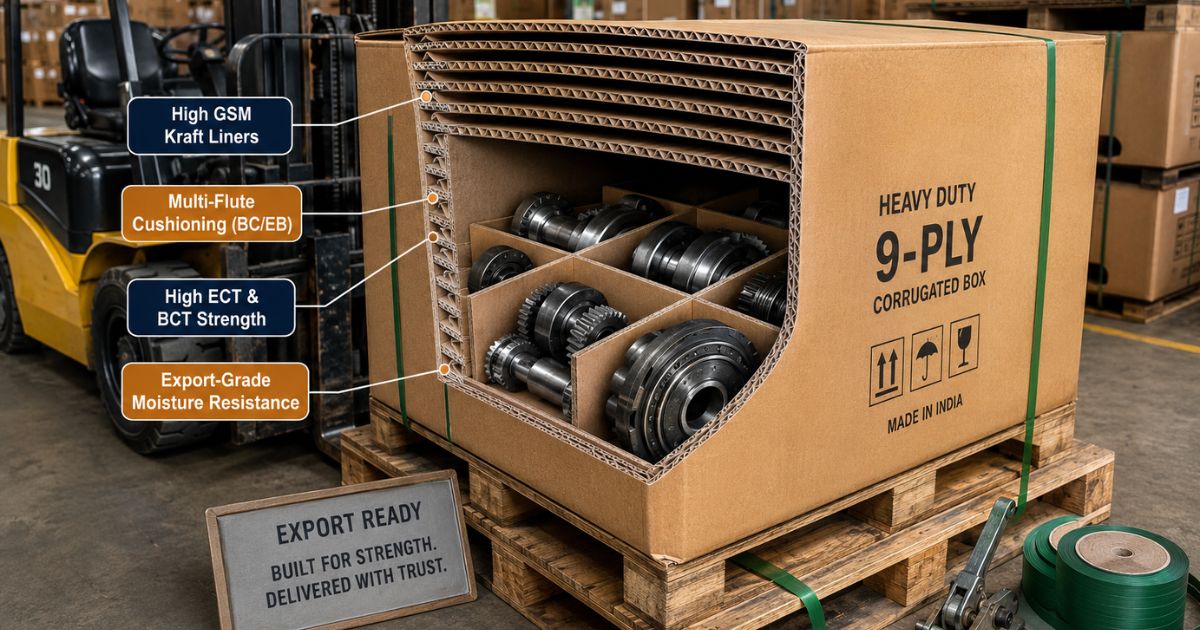
When products are heavy, sharp-edged, high-value, or travelling thousands of kilometers across rough logistics routes, ordinary cartons fail. Corners crush, flutes collapse, and stacked loads buckle inside containers. This is where the heavy duty 9 ply corrugated box becomes the practical answer, not a marketing claim, but a structural solution engineered for load, distance, and risk.
For manufacturers moving automotive parts, castings, tools, electrical hardware, pumps, bearings, or machinery components, packaging is no longer about wrapping, it’s about load engineering. That’s why export quality corrugated boxes in the 9-ply category have become the benchmark for industrial packaging boxes in India relies on for safe transit.
This guide breaks down the technical reasons 9-ply works, where it is necessary, and how to specify it correctly.
A 9-ply board is built from five liner boards and four fluted mediums bonded together in an alternating structure. This creates a thick, shock-absorbing, compression-resistant wall designed for extreme stacking and impact.
Typical construction (outside → inside):
Liner → Flute → Liner → Flute → Liner → Flute → Liner → Flute → Liner
This multi-wall architecture delivers:
A heavy duty 9 ply corrugated box is not chosen for light goods. It’s specified when failure is expensive.
Export pallets are stacked inside containers up to the roof height. Lower cartons bear the weight of everything above. 3-ply or 5-ply boards deform; 7-ply may survive short runs. 9-ply is built for sustained compression.
Indian road logistics plus sea freight equals constant vibration. Multiple flute layers act like shock absorbers, preventing metal parts from damaging the carton from inside.
Heavy components concentrate load on edges. 9-ply walls resist edge collapse during strapping and forklift handling.
With proper GSM and kraft quality, these become true export quality corrugated boxes that tolerate humidity swings in ports and containers.
Sharp castings, machined parts, and tools don’t tear through the walls easily due to multi-layer liners.
Industries that routinely specify industrial packaging boxes in India in 9-ply:
If your box weight crosses ~25 kg or your product has edges/metal mass, lighter ply is a gamble.
A true heavy duty 9 ply corrugated box is not defined by ply count alone. These parameters matter:
|
Parameter |
Typical Range for 9-Ply Industrial Use |
Why It Matters |
|
GSM (liners) |
180–300 GSM kraft |
Wall stiffness & moisture resistance |
|
Flute profile |
Mixed (BC/EB combinations) |
Cushioning + compression balance |
|
BF (Bursting Factor) |
35–45+ BF |
Resistance to rupture |
|
ECT |
High ECT rating |
Edge load performance |
|
BCT |
Tested as per load |
Stacking safety |
|
Adhesive bonding |
High-strength starch/chemical |
Layer integrity |
|
Moisture control |
Treated kraft options |
Export durability |
Without these, “9-ply” is just thickness, not strength.
During export, cartons face:
This is exactly where export quality corrugated boxes in 9-ply prevent losses that cheaper packaging causes.
Many buyers hesitate due to higher cost per box. But the real comparison is:
Cost of stronger box vs cost of one damaged shipment
For industrial goods, one damaged pallet can exceed the yearly cost difference between 7-ply and 9-ply. That’s why experienced purchase managers standardize 9-ply for critical SKUs.
Choose a heavy duty 9 ply corrugated box if:
If you tick 3+ boxes here, 9-ply is justified.
Beyond ply strength, performance improves with:
Strength + fitment = true industrial packaging.
Not every supplier can produce consistent 9-ply quality. Layer bonding, GSM control, flute selection, and testing facilities decide real performance.
Working with an experienced 9 ply box manufacturer in Jharkhand, like Devendra Packaging, ensures:
That’s critical when your packaging is part of your quality assurance.
Over time, industries learned the hard way that under-specifying packaging leads to:
So, 9-ply didn’t become popular by trend. It became standard by failure analysis.
Today, for industrial packaging boxes in India uses in heavy sectors, 9-ply is the safe baseline.
A heavy duty 9 ply corrugated box is not over-packaging. It is risk control for heavy, valuable, and export-bound goods.
If your products are heavy, your routes are long, and your reputation matters, 9-ply is not an expense, it’s insurance built into the carton.
And when sourced from a reliable 9 ply box manufacturer in Jharkhand such as Devendra Packaging, these export quality corrugated boxes become a dependable part of your logistics system, not a weak link.
In industrial logistics, strength is not optional. It is specified.