
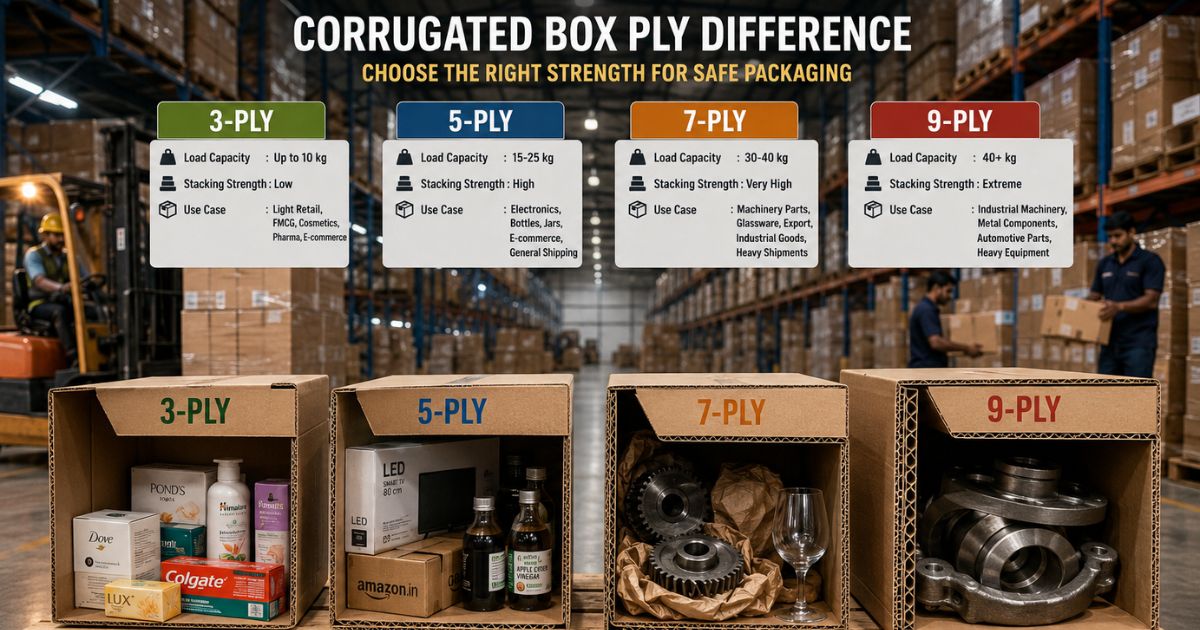
Choosing the right corrugated box is not about picking the thickest board. It’s about matching ply strength with product weight, stacking load, transit distance, and handling conditions. Many businesses overspend on higher ply boards they don’t need, or worse, under-specify packaging and suffer product damage in transit.
This guide explains the corrugated box ply difference in practical, technical terms so you can select the exact board strength your product requires.
A corrugated board is made by sandwiching fluted paper between liner sheets. Each liner and flute layer counts as a ply.
As ply increases, compression strength, burst strength, and stacking capacity increase.
A 3 ply corrugated box is designed for lightweight products and short transport cycles.
Structure: Liner + Flute + Liner
Best for:
Typical Load Capacity: Up to 8-10 kg
Advantages:
Limitations:
If your cartons are failing during stacking, you’re probably misusing 3 ply where 5 ply is required.
This is the industry workhorse. Any reliable 5 ply corrugated box manufacturer will recommend this for most shipping needs.
Structure: Liner + Flute + Liner + Flute + Liner
Best for:
Typical Load Capacity: 15-25 kg
Advantages:
For most SMEs and manufacturers, 5 ply is the correct default choice unless the product is extremely light or very heavy.
When products are heavy, fragile, or exported, 7 ply corrugated packaging in India standard is commonly used.
Structure: Liner + Flute + Liner + Flute + Liner + Flute + Liner
Best for:
Typical Load Capacity: 30-40 kg
Advantages:
If your goods travel across states or countries, 7 ply is often cheaper than product damage.
9 ply boxes are not common for regular businesses. They are used where extreme load bearing and maximum stacking are required.
Best for:
Typical Load Capacity: 40+ kg
Advantages:
This is overkill for 90% of businesses.
|
Ply Type |
Layers |
Load Capacity |
Use Case |
Cost |
Stacking Strength |
|
3 Ply |
3 |
Up to 10 kg |
Light retail, FMCG |
Low |
Low |
|
5 Ply |
5 |
15-25 kg |
Standard shipping |
Medium |
High |
|
7 Ply |
7 |
30-40 kg |
Export, heavy goods |
High |
Very High |
|
9 Ply |
9 |
40+ kg |
Industrial use |
Very High |
Extreme |
This table summarizes the real corrugated box ply difference that impacts your packaging decision.
Do not choose based on guesswork. Decide using these 5 factors:
If you ignore these, you either waste money or risk damage.
A professional packaging partner like Devendra Packaging evaluates all these before recommending board grade and ply.
A true 5 ply corrugated box manufacturer or heavy-duty box supplier doesn’t just sell boxes. They calculate:
Ply alone is not enough. Board specification matters.
This is where experience matters. Devendra Packaging engineers corrugated solutions based on load analysis, not assumptions.
Upgrade immediately if you notice:
These are clear signs you misunderstood the corrugated box ply difference.
If you’re unsure, don’t guess. Get your packaging audited.
Devendra Packaging specializes in manufacturing corrugated boxes with precise ply selection, correct GSM liners, and scientifically chosen flute combinations for Indian logistics conditions.
Instead of selling you the thickest box, they supply the right strength box for your product, saving cost and preventing damage.
Understanding the corrugated box ply difference is essential for cost control and product safety. The right ply improves stacking, reduces transit damage, and optimizes packaging cost.
Before placing your next order, evaluate your need, or consult Devendra Packaging to engineer the correct corrugated solution for your business.